Showing posts with label whodunit. Show all posts

Tuesday, June 25, 2024

The Slow Burn Thriller

 It might seem to be an oxymoron to put slow burn and thriller together as a descriptor of a novel.


Yet the traditional murder mystery fits those two terms quite well. For its pacing is very much slow burn and when appropriate thrilling.


Thrillers Then and Now


Back in my youth, some 60 years ago, the definition of a thriller was quite precise: an action–packed read where the protagonist had X amount of time to stop the antagonist from blowing up a building, destroying a city, or even eliminating the planet itself.


Today, in the world of crime fiction, everything is a thriller — whether the story is thrilling or not. Today, the term “thriller” has very little to nothing to do with the content of a novel. “Thriller” is an advertising term that is used because of the belief that readers want exciting and thrilling action and nothing else.


The term “thriller” is a marketing tool that is applied to everything in order to get sales, which means the term has ceased to have any meaning. If everything is a thriller, then nothing is. Besides, I’ve read a number of boring, dull, and unexciting “thrillers”. Which only accentuates the meaninglessness of the term.


To be honest, thrillers aren’t my thing. Even when the Thriller was a well-defined crime fiction sub-genre. I enjoy thrills in my story and thrilling scenes, but I’m not interested in nothing but thrill producing scenes on every page.


This is mostly due to the fact I read for the characters, and not the plot. I want to read about people trying to get out of a dilemma. I’m not interested in stuff blowing up or shootouts occurring simply to raise the adrenaline level.


Enter Justinia Wright and the Traditional Mystery


When I was young, I didn’t read mysteries. Except for Sherlock Holmes and the occasional Thinking Machine story.


I much preferred science fiction, horror, and sea adventures. It wasn’t until I was around 30 that I truly discovered mysteries and fell in love with them. Thanks to a librarian named Marilyn Gray, who was an avid mystery reader. She is the one who introduced me to Nero Wolfe. And I am forever grateful.


For me, it was love at first read. I loved the characters. The stories were intriguing. And the writing style of Rex Stout was superlative. Only Raymond Chandler could give him a run for his money.


When I decided to get serious about writing fiction, it was the classic whodunit I set out to write.


The result was Festival of Death. Justinia “Tina” Wright and her brother, Harry, were inspired in part by Nero Wolfe and Archie Goodwin.


Author Richard Schwindt observed: “…why would someone do that most difficult of pastiches, Nero Wolfe, as perfected by Rex Stout? Why not take that format and create it afresh, as CW Hawes has done…”


To capture the essence of a fictional world, and recreate it into something fresh is a difficult task. The easy route is the pastiche.


I am very pleased that not only Mr. Schwindt, but others have caught on to what I attempted and pronounced it satisfactory. Justinia Wright has become a win for me, the writer, and a win for those readers who like the classic slow burn thriller.


Slow Burn Thriller


The whodunit is by nature a cerebral enterprise. A game of collection and analysis. The plot is simple: A kills B, the police think the killer is C, until the detective shows them it’s A.


What makes the difference is style, as Raymond Chandler noted.


Which might explain all of the kooky and quirky characters inhabiting the pages of mystery fiction.


By nature, mysteries start slow. And build up steam and momentum as you read, until they reach the whizz-bang climax. That is the slow burn thriller in action.


Obviously, some readers will find the formula not to their liking. They don’t want to follow a trail of breadcrumbs. They don’t want to solve a puzzle. They want things exploding on page one, and the hero taking out a platoon of assassins on page two using a pen knife as his only weapon.


That just isn’t how it’s done in the traditional whodunit world. And that’s okay. Because there are enough writers and readers so that every writer has an audience and every reader has a writer he enjoys.


If you want a more cerebral than visceral read; a read that stimulates the mind, yet also the senses; is entertaining; and still delivers plenty of action — then I invite you to enter the world of Justinia Wright. The Justinia Wright Private Investigator Mysteries.


They are doggone good slow burn thrillers, if I do say so myself.


And I’m glad to say there are others who say so with me: “I loved this book. Loved the characters. And, I love how Hawes spins his stories.” Thank you, gentle reader.


Oh, and you needn’t start with Festival of Death. Each book is a standalone mystery. (One of my personal favorites is Book 7: Death Makes a House Call.) Yet there is an overarching character storyline you will find interesting if you read the series in order.


And if you like freebies, join my mailing list and get Vampire House and other early cases of Justinia Wright, PI for free. Sign up at BookFunnel.
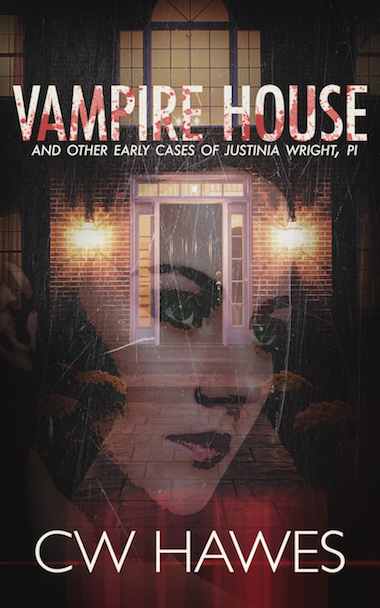


Otherwise, pick up the books on Amazon.


Comments are always welcome! And until next time, happy reading!


CW Hawes is a playwright; award-winning poet; and a fictioneer, with three bestselling novels. He’s also an armchair philosopher, political theorist, social commentator, and traveler. He loves a good cup of tea and agrees that everything’s better with pizza.


If you enjoyed this post, please consider buying me a cup of tea. Thanks! PayPal.me/CWHawes 


Justinia Wright Private Investigator Mysteries on Amazon!


Magnolia Bluff Crime Chronicles on Amazon!

Tuesday, September 20, 2022

The Shine from a Girl in the Lake Sample


The Shine from a Girl in the Lake by Richard Schwindt launches today. It is book number 6 in the Magnolia Bluff Crime Chronicles series. And it is a winner.


Schwindt is one of my favorite contemporary writers. And he may even be on my all time top 10 list. He is that good.


In my previous post, I talked a little bit about mysteries and his latest book. In this post, I thought I’d give you a sample of the goodness that is in store for you when you pick up your copy.


Because if you want fiction that gives you a sense of place, is filled with suspense, is poignant, and is seasoned with humor, then Schwindt’s fiction is for you.


And now, sit back and enjoy the sample.


Week 1 


Chapter 1
Sunday afternoon 


I knew what a Walker Coonhound could do, but my experience with Butch mostly involved watching him roll over, and invite me to rub his belly on the days I wandered next door to drink with Jack Rice.


This didn’t prepare me for the furious restraint of the animal now stalking beside me in the hot brush, ten miles outside of Magnolia Bluff. His hackles rose stiff as knives, and his mouth curled in a rictus of canine rage and anticipation.


I had thought the recurve bow with a seventy-pound draw would do the job, but now I was not so sure. Deciding to kill a rogue boar, was easy. Executing the plan much more of a challenge. Judging from Butch’s demeanor, we were close indeed.


A review of the topographic map suggested the existence of a hollow in the next hundred yards; adjacent to a gorge, probably ringed with the ubiquitous juniper scrub.


Melanie Fairchild had spent her twenty-fifth year alone in a house in town, self- imprisoned with agoraphobia. She met a charming man online, who lured her out, impregnated her in his trailer, married her, and then ran away for good.


She was left with mixed memories of love and loss, a nice little boy named Seth, and an incentive to get out into the world. She inherited a run-down ranch when her mother passed, and managed to make a quiet living producing soybeans and goat milk.


Melanie counted on me to help keep her anxiety at bay, and manage the stresses of single motherhood.


Now a goddam feral hog threatened to undo her gains.


Two weeks ago, it appeared on the edge of an escarpment situated by the south end of her property. One week later, it had killed her Cocker Spaniel, Lady, while she and Seth watched in horror from the doorway.


Terrified, Melanie had booked three sessions last week. She had one girlfriend driving her to my office at the college, and another, armed, watching Seth, who was no longer allowed to play outside. This hog was smart. She kept a loaded lever action 30-30 by the door, but he didn’t show his ugly face again. She knew he was around, likely in the hollow where the feral hogs clustered.


Psychotherapists are supposed to do therapy; not solve people’s problems for them. Melanie was now 32, pretty, and probably harboring erotic transference for me.


I knew this was a bad idea, but another part of me wanted the thrill of the chase, and to do Jack Rice a favor.


Jack, 72, had been in the wrong part of the Mekong delta in 1968, when his buddy, just ahead, stepped on a Bouncing Betty mine. The other guy was shredded, but Jack lost his left leg, and sent home with a Purple Heart.


It was a bad start to adulthood. Jack stayed single, but forged a good life for himself running a garage, and hunting the hill country with his dog, and prosthesis. Two years ago, diabetes took the other leg. No more hunting, and time to retire.


He took the loss with surprising equanimity, telling me he considered every day since the Tet Offensive a bonus.


He still drank a bit, made his way to the coffee shop to bullshit with the boys, and walked Butch from the seat of his VA issue electric wheelchair. He even drove an old beater truck with hand controls.


I found Jack garrulous and opinionated, but a decent drinking buddy, and a great source of intelligence on local hunting.


“Take Butch with you tomorrow,” he said Saturday night, over a glass of whisky. “You may not find the hog without him, and, hell, it might find you first. Let Butch even the odds. Nothing meaner than a cornered boar.” He wasn’t finished. “And if I thought you’d listen, I’d tell you to take a rifle instead of the recurve. You’ll need to be awful close to hit it square.”


I laughed. “I’ll be fine, Jack. No need to fuss. If I get it, I’ll gut him and bring it back for you to butcher. All I’ll want is a roast and a couple of chops.”


He grinned and raised his glass.


I was a little drunk and cocky, sparing a glance to the friendly dog in the corner. Butch wagged his tail. “What’s he going to do? He’s too nice to hunt.”


“Just take him, stalk the hog, and let him do his thing. I trained him before I lost the leg; he knows hogs better than you.”


I waved away a fly with the corner of my bow as we tramped down a pathway. With the insidious arrival of late afternoon, shadows from the October sun lengthened around me.


As Butch stiffened, I unconsciously drew a broad head arrow from my hip quiver. My sympathetic nervous system activated, I felt the increase in muscle tension, respiration and heart rate.


Without notice, Butch bolted down the path, ears glued to his head. About 15 yards along he turned sharply to the right. That had to be the hollow. I started to jog after him, but he had begun to bay. Finding him would not be a problem.


Now I was running, and turned the corner almost as fast as he had. I pulled up sharply.


Maybe another 15 yards away, Butch was nose to nose with the boar.


No one told me it would be that big; it must have topped 200 pounds, dwarfing the enraged hound. Covered in stiff bristles, it rocked on its feet, obviously ready to fight back, but temporarily intimidated.


Butch never let up the baying, even when the boar noticed my appearance on the fringe of the hollow. That had to be the right hog; he was smart and mean. And he made the smart decision. To charge.


Charge me.


I had the arrow nocked, but he was halfway to me by the time I began my draw. The dog never lost a beat; pivoting, lunging and sinking his teeth into the boars’ ear.


This provided the opportunity to pivot myself, and line up for a clean shot. I drew. Damn dog was in the way. Christ, try telling Jack I shot his dog. Butch wasn’t letting go, probably saving both of us.


I shuffled to one side just as the boar turned to the other. With one fluid motion, I drew and fired.


It screamed like a human being, one long, pained wail, culminating with spindly legs collapsing from under it. Bullseye.


Butch and I felt that crazy elation that follows a kill. He circled the dead boar, panting. And me; I felt like I wanted to show up at Melanie’s house with the carcass, and then fuck her.


I returned to earth quickly. The carcass was promised to Jack, Melanie was vegan, you don’t sleep with clients, and I had a large pig to gut and drag back to my truck. I sighed and removed my pack. Time to dig out the knife. Dark would soon find us.


Butch still panted, while bleeding from one ear and a puncture wound on his thigh. He wagged his tail. The dog was happy.


***


Hope you enjoyed the sample. The Shine from a Girl in the Lake is live today. Get your copy on Amazon!


Comments are always welcome! And until next time, happy reading!


CW Hawes is a playwright, award-winning poet, and a fictioneer, with a bestselling novel. He’s also an armchair philosopher, political theorist, social commentator, and traveler. He loves a good cup of tea and agrees that everything’s better with pizza.


If you enjoyed this post, please consider buying me a cup of tea. Thanks! PayPal.me/CWHawes

Tuesday, September 13, 2022

The Shine from a Girl in the Lake


In The Simple Art of Murder, Raymond Chandler excoriates the classic detective story as unrealistic. And he is undoubtedly correct.


All one has to do is look at Edgar Allan Poe’s seminal detective, C. Auguste Dupin, to realize that the classic detective story was never intended to portray reality. The stories may possess elements of reality, but they are not reality the school of Realism would like. Fiction, after all, is fiction. It’s make believe.


But neither is the hardboiled world of Hammett or Chandler realistic. It’s simply much more gritty, depressing, and pessimistic. But that doesn’t make it real.


The world of Spade and Marlowe is just as unrealistic as is the world of Wolfe and Poirot. They are simply different unrealities.


Chandler’s defense of the hardboiled world was undoubtedly a case of self-justification.


Poe was an accomplished storyteller. His settings weren’t always real, but the atmosphere he evoked was something we can still touch and feel and smell and taste today. He leads us into believing his world is real — and that is what actually matters.


The classic detective story in the hands of a good writer does the same: it convinces us to accept what takes place as real, even though we know it’s not.


But more than that, what Poe actually gave us was a literary game. A LitRPG, as it were. The game of Clue, before it was invented.


The classic detective story is a cerebral exercise. It is a cognitive analysis of data to determine what is relevant and what is not in order to determine who did it. Who murdered Mr. Body and why. It’s also a whole lot of fun. It is a game after all.


The Magnolia Bluff Crime Chronicles is a series of exciting whodunits. Each book is crafted by a different author, and each is set in the charming Texas Hill Country town of Magnolia Bluff.


Five books have been published to date. They are:


Death Wears a Crimson Hat by CW Hawes


Eulogy in Black and White by Caleb Pirtle III


The Great Peanut Butter Conspiracy by Cindy Davis


You Won’t Know How… Or When by James R. Callan


The Flower Enigma by Breakfield & Burkey


And you can find them all on Amazon!


On September 20th, The Shine from a Girl in the Lake by Richard Schwindt will join the series. The book is currently on pre-order, so pick up your copy today.


I’ve read an advanced review copy and I can tell you the book is fabulous. It possesses all the elements of the classic whodunit coupled with the tension of a serial killer thriller.


Richard Schwindt is one of my favorite authors. In fact, I think he is one of the finest storytellers spinning yarns today.


His books are highly imaginative. Poignant. Often hilariously funny. His prose is imbued with a sense of place. He makes you feel you are there.


And all those elements come together to make The Shine from a Girl in the Lake one heck of a mystery-thriller.


Dr. Michael Kurelek teaches psychology at Burnet College in Magnolia Bluff. He also has his own private practice. He’s a man with a past looking for a new start in the small Texas town. Then one of his patients is found dead. In Burnet Reservoir.


When another patient ends up in the lake, Kurelek is driven to find the real killer before the police decide they are convinced he did it. The game is afoot. And it is a suspense-filled game of hunter and hunted. The ending had me biting my nails. Seriously.


The Shine from a Girl in the Lake is the perfect blending of classic whodunit and serial killer thriller. A fabulous book from the pen of one of the most imaginative writers working today.


Don’t miss this one.


The Shine from a Girl in the Lake

on Amazon


Comments are always welcome! And until next time, happy reading!


CW Hawes is a playwright, award-winning poet, and a fictioneer, with a bestselling novel. He’s also an armchair philosopher, political theorist, social commentator, and traveler. He loves a good cup of tea and agrees that everything’s better with pizza.


If you enjoyed this post, please consider buying me a cup of tea. Thanks! PayPal.me/CWHawes

Tuesday, August 23, 2022

The Lawyer: Meet the Characters of Magnolia Bluff

Magnolia Bluff, Texas. Situated in the heart of the Texas Hill Country, on the shore of Burnet Reservoir.


It’s a quaint little town, filled with all manner of interesting people. Of course some of those folk are deadly. You tick them off and you’re likely to find yourself six feet under and breathing dirt when you wake up.


The Flower Enigma, Book 5 in the Magnolia Bluff Crime Chronicles series, launched this past weekend, and Book 6, The Shine from a Girl in the Lake, is on pre-order and will be available in September.


I’ve read both books and they are well worth a buck. Heck, they’re well worth several bucks. So pick them up while they are at their launch and pre-launch special price.


Buy The Flower Enigma


Buy The Shine from a Girl in the Lake


In this post, I want to introduce you to Stanton Mirabeau Lauderbach, Esq. The lawyer we meet in Death Wears a Crimson Hat, which is the first book in the Magnolia Bluff Crime Chronicles.


If you visit Magnolia Bluff and find yourself in trouble, he’s the guy you want to call.


Attorney Stanton Lauderbach is hired to defend the reputation of a lady preacher who may or may not be accused of murder.


He’s tough.


He’s smart.


Two-bit cops don’t frighten him.


He knows how to play the game.


He’s played it before.


In Death Wears A Crimson Hat, Book 1 in the Magnolia Bluff Crime Chronicles, Attorney Stanton Lauderbach is hired to defend the reputation of a lady preacher who may or may not be accused of murder.


He doesn’t try to make fools of small town cops.


He lets them make fools of themselves.


And the lawyer loves every minute of it.


May the best team win.


***


There was a knock, and a man stuck his head in. Detective Reece Sovern turned around and said, “What are you doing here, Stanton?”


“I’m here to talk to Reverend Cole. I’m her legal counsel.”


“You’re what?” Sovern demanded.


“I didn’t hire you,” Ember said.


“No, you didn’t, Ms. Cole. A friend hired me on your behalf in case you needed legal advice.” Stanton Lauderbach nodded towards Sovern, to emphasize his point, and continued, “Stanton Lauderbach, Esquire at your service, and it looks as though I got here just in time.”


“Look Stanton, the Reverend and I are just having a chat. I’m not arresting her.”


“But she is a person of interest. Is she not?”


Reece Sovern took his glasses off and ran his hand over his face. “Yes, the Reverend is a person of interest.”


“Then I arrived just in time.” Lauderbach sat in the chair next to Sovern. “Continue, Reece.”


Sovern put his glasses back on, took in a deep breath, and exhaled. “Ms. Cole, did you know that your friend, Harry Thurgood, paid Mary Lou Fight a visit yesterday, and, according to her husband, threatened her?”


Lauderbach held up his hand to stop Ember from replying. “And what does that have to do with Ms. Cole? Shouldn’t you be discussing Mr. Thurgood’s alleged threat with him?”


Ember looked from Sovern, to the lawyer, and then back to the police investigator.


Sovern stood. “You want to make this difficult, don’t you, Stanton?”


“Just doing my job.”


“Yeah, right. Well, I’ll leave you two to whatever business you have. Ms. Cole. Stanton.”


The police investigator left, and Ember took in the man sitting before her. He was immaculately dressed in a three-piece charcoal gray suit. His dark hair was combed straight back from his high forehead, but stood out from his head, giving a very full appearance. He had an aquiline nose and thin lips. But what she found most impressive were his piercing, almost feral eyes. And his smile: genuine, but rather too genuine.


“Who hired you?”


“I’m not at liberty to say.”


“Really?”


“That was the condition your benefactor put on the arrangement.”


“I see. Why are you here?”


“To meet you and find out what Detective Sovern has asked you thus far.”


“And if I say no to your services?”


“If I may be direct…”


Ember nodded.


“You’d be a fool to do so. I’m the best in the county at this sort of thing.”


“Modest, aren’t we?”


Lauderbach smiled. “No, I’m not. But I am the best, which is why Sovern left. He was fishing. Which is good for him and bad for you. He has no evidence you are involved. Let him come back when he has some. Now, what has he asked you about?”


Ember filled in the attorney on her interactions with Reece Sovern.


When she was finished, Stanton Lauderbach fished a card out of his suit coat pocket and handed it to her. He stood. “Call me, no matter the time, whenever someone official shows up.”


“Aren’t you going to ask if I’m innocent?”


Lauderbach smiled, and Ember could’ve sworn his eyes glowed. “My job is to defend you. Period. Guilt or innocence is up to judge and jury. Good day, Reverend Cole.”


Ember watched him leave, and then studied the chair in which he’d been sitting. She pursed her lips, then picked up her desk phone. “This is Harry’s doing,” she muttered, started punching in numbers, but stopped before she was finished.


Her eyes took in her Bible, and she returned the phone to the cradle. She mouthed the verse: Be welcoming to strangers; because, by doing so, some have entertained angels and didn’t realize it.


She sat back in her chair, and softly said, “Maybe Harry is an angel.”


Please click HERE to find Death Wears A Crimson Hat on Amazon.


And you can find Caleb Pirtle’s original post which I borrowed with his permission on his website: https://www.calebandlindapirtle.com/the-lawyer-meet-the-characters-of-magnolia-bluff/


Comments are always welcome. And until next time, happy reading!


CW Hawes is a playwright, award-winning poet, and a fictioneer, with a bestselling novel. He’s also an armchair philosopher, political theorist, social commentator, and traveler. He loves a good cup of tea and agrees that everything’s better with pizza.


If you enjoyed this post, please consider buying me a cup of tea. Thanks! PayPal.me/CWHawes