Showing posts with label Justinia Wright Private Investigator Mysteries. Show all posts

Wednesday, October 23, 2024

The Slow Burn Mystery

 Thrillers are all the rage today. In fact, just about every genre must have thrills and spills starting on page 1. Things blowing up and pistols blazing. And people running. Gotta have people running.


If someone took one of Agatha Christie’s novels, dropped her name, change the character names, and put the book in the 21st century — a dime to a doughnut it wouldn’t sell. Why? Because there’s nothing thrilling going on. The books are puzzles. The sleuth hunting for clues. A game between writer and reader to see if the reader can out guess the sleuth.


Wordle aside, who does puzzles anymore?


Raymond Chandler’s estate has tried unsuccessfully for years to make a cash cow out of Philip Marlowe. They failed. Why? Because Marlowe isn’t thriller material. He’s an introspective armchair philosopher, who happens to also be a private detective, putting together a puzzle to solve a crime. There are some thrilling moments, but the books aren’t thrillers. And never will be if Marlowe stays Marlowe.


I write mysteries. What I’m now calling slow burn mysteries to differentiate them from thrillers. And what some are calling mystery thrillers in order to make mysteries more popular.


Too often I’ve seen people start reading Festival Of Death (Justinia Wright Private Investigator Mysteries, Book 1) on Kindle Unlimited and then quit just before they get to the exciting part. They’ve gone through the build up and leave before the reward.


It’s akin to going to a restaurant, waiting in line, and then leaving just before your name is called.


Why do readers do this? I think this is mostly due to today’s reader expecting a thriller and not getting it. Even when there’s nothing in the book description to lead them to believe the book is a thriller. In the mindset of today’s reader all mystery and suspense novels are thrillers. And that is unfortunate. For both the reader and the writer.


So I’m going to start calling my mysteries (and traditional mysteries in general) — Slow Burn Mysteries.


Now what does slow burn mystery mean?


A book that is a slow burn mystery is a mystery that starts at the beginning and follows the detective through to the grand announcement of who did it.


These are the mysteries of the Golden Era. The mysteries of Christie, Stout, Wentworth, Marsh, the Lockridges, and so many more.


The story generally follows a 5-act structure, as follows:


Act I — We meet the sleuth, the characters, and learn of the problem to be solved.


Act II — The sleuth, having accepted the case, the challenge to solve the crime, begins gathering clues. This is the part where the detective obtains info, but doesn’t see how it all fits together.


Act IIIa — At this point the detective often gets frustrated and may even try to quit. Nothing is making sense.


Midpoint — With the sleuth thinking the case will never be solved, he suddenly obtains a key clue or realizes the true import of something he already found out but misinterpreted.


Act IIIb — Armed with his new knowledge or understanding, the sleuth begins to close in on the villain.


Act IV — The sleuth gathers all he needs to expose the villain and secure justice.


Act V — The villain is exposed and hauled off to jail and everything goes back to normal.


If you read a Sherlock Holmes story, or a Nero Wolfe mystery, or a Hercule Poirot novel, they all more or less follow this structure. There are very few to no instances of things blowing up or gun fights taking place. These are drawing room dramas with little violence and bloodshed occurring on stage.


And in spite of Raymond Chandler’s excoriation of British mysteries, his Philip Marlowe novels basically follow this same structure. 


Marlowe goes about gathering clues, while giving us his outlook on life. There are few to no chase scenes. No gun fights. Nothing blowing up. Just Marlowe talking to people and gathering clues. Yet these are some of the most literary crime fiction books you’ll ever read. But they are 100% slow burn.


The slow burn mystery is like the slow burn horror tale: the fuse is burning, getting closer and closer to the powder keg. And then there is the big bang.


Satisfaction awaits you — and it’s worth the wait.


Comments are always welcome! And until next time, happy reading!


CW Hawes is a playwright; award-winning poet; and a fictioneer, with three bestselling novels. He’s also an armchair philosopher, political theorist, social commentator, and traveler. He loves a good cup of tea and agrees that everything’s better with pizza.


If you enjoyed this post, please consider buying me a cup of tea. Thanks! PayPal.me/CWHawes 


Justinia Wright Private Investigator Mysteries on Amazon!


Magnolia Bluff Crime Chronicles on Amazon!

Tuesday, August 20, 2024

Big Sale and a Book Launch

 It’s a triple play today through Thursday.


Magnolia Bluff Sale


Second Chances by Joe Congel is free 20-22 August. That’s today, tomorrow, and Thursday. Grab your copy at Amazon.


And get the rest of the books in the series for only 99¢ each. Grab them on Amazon.


MBCC Book Launch


Book 27 of the Magnolia Bluff Crime Chronicles is now live. The Ransom Enigma. Written by the dynamic duo of Breakfield & Burkey.


Get the book on Amazon.


Justinia Wright Private Investigator Mysteries


I’ve put the Justinia Wright series on sale through Thursday to give you extra crime fiction reading.


Now is the time to stock up on the books you’re missing before I start adding more books to the series.


Minnesota’s answer to Nero Wolfe is available on


Amazon for 99¢


So pick yourself up a pile of good reads for dirt cheap.


These pixels gotta go and the price can’t be better.


Comments are always welcome! And until next time, happy reading!


CW Hawes is a playwright; award-winning poet; and a fictioneer, with three bestselling novels. He’s also an armchair philosopher, political theorist, social commentator, and traveler. He loves a good cup of tea and agrees that everything’s better with pizza.


If you enjoyed this post, please consider buying me a cup of tea. Thanks! PayPal.me/CWHawes

Tuesday, June 25, 2024

The Slow Burn Thriller

 It might seem to be an oxymoron to put slow burn and thriller together as a descriptor of a novel.


Yet the traditional murder mystery fits those two terms quite well. For its pacing is very much slow burn and when appropriate thrilling.


Thrillers Then and Now


Back in my youth, some 60 years ago, the definition of a thriller was quite precise: an action–packed read where the protagonist had X amount of time to stop the antagonist from blowing up a building, destroying a city, or even eliminating the planet itself.


Today, in the world of crime fiction, everything is a thriller — whether the story is thrilling or not. Today, the term “thriller” has very little to nothing to do with the content of a novel. “Thriller” is an advertising term that is used because of the belief that readers want exciting and thrilling action and nothing else.


The term “thriller” is a marketing tool that is applied to everything in order to get sales, which means the term has ceased to have any meaning. If everything is a thriller, then nothing is. Besides, I’ve read a number of boring, dull, and unexciting “thrillers”. Which only accentuates the meaninglessness of the term.


To be honest, thrillers aren’t my thing. Even when the Thriller was a well-defined crime fiction sub-genre. I enjoy thrills in my story and thrilling scenes, but I’m not interested in nothing but thrill producing scenes on every page.


This is mostly due to the fact I read for the characters, and not the plot. I want to read about people trying to get out of a dilemma. I’m not interested in stuff blowing up or shootouts occurring simply to raise the adrenaline level.


Enter Justinia Wright and the Traditional Mystery


When I was young, I didn’t read mysteries. Except for Sherlock Holmes and the occasional Thinking Machine story.


I much preferred science fiction, horror, and sea adventures. It wasn’t until I was around 30 that I truly discovered mysteries and fell in love with them. Thanks to a librarian named Marilyn Gray, who was an avid mystery reader. She is the one who introduced me to Nero Wolfe. And I am forever grateful.


For me, it was love at first read. I loved the characters. The stories were intriguing. And the writing style of Rex Stout was superlative. Only Raymond Chandler could give him a run for his money.


When I decided to get serious about writing fiction, it was the classic whodunit I set out to write.


The result was Festival of Death. Justinia “Tina” Wright and her brother, Harry, were inspired in part by Nero Wolfe and Archie Goodwin.


Author Richard Schwindt observed: “…why would someone do that most difficult of pastiches, Nero Wolfe, as perfected by Rex Stout? Why not take that format and create it afresh, as CW Hawes has done…”


To capture the essence of a fictional world, and recreate it into something fresh is a difficult task. The easy route is the pastiche.


I am very pleased that not only Mr. Schwindt, but others have caught on to what I attempted and pronounced it satisfactory. Justinia Wright has become a win for me, the writer, and a win for those readers who like the classic slow burn thriller.


Slow Burn Thriller


The whodunit is by nature a cerebral enterprise. A game of collection and analysis. The plot is simple: A kills B, the police think the killer is C, until the detective shows them it’s A.


What makes the difference is style, as Raymond Chandler noted.


Which might explain all of the kooky and quirky characters inhabiting the pages of mystery fiction.


By nature, mysteries start slow. And build up steam and momentum as you read, until they reach the whizz-bang climax. That is the slow burn thriller in action.


Obviously, some readers will find the formula not to their liking. They don’t want to follow a trail of breadcrumbs. They don’t want to solve a puzzle. They want things exploding on page one, and the hero taking out a platoon of assassins on page two using a pen knife as his only weapon.


That just isn’t how it’s done in the traditional whodunit world. And that’s okay. Because there are enough writers and readers so that every writer has an audience and every reader has a writer he enjoys.


If you want a more cerebral than visceral read; a read that stimulates the mind, yet also the senses; is entertaining; and still delivers plenty of action — then I invite you to enter the world of Justinia Wright. The Justinia Wright Private Investigator Mysteries.


They are doggone good slow burn thrillers, if I do say so myself.


And I’m glad to say there are others who say so with me: “I loved this book. Loved the characters. And, I love how Hawes spins his stories.” Thank you, gentle reader.


Oh, and you needn’t start with Festival of Death. Each book is a standalone mystery. (One of my personal favorites is Book 7: Death Makes a House Call.) Yet there is an overarching character storyline you will find interesting if you read the series in order.


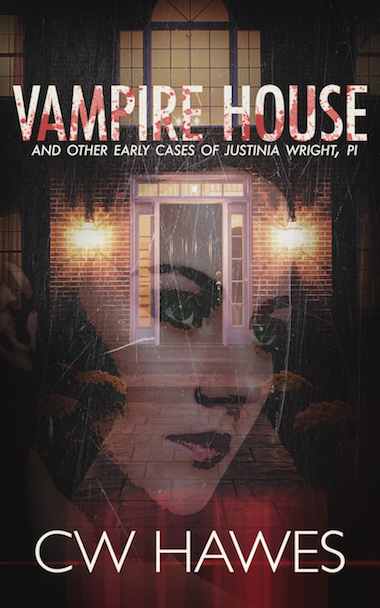
And if you like freebies, join my mailing list and get Vampire House and other early cases of Justinia Wright, PI for free. Sign up at BookFunnel.


Otherwise, pick up the books on Amazon.


Comments are always welcome! And until next time, happy reading!


CW Hawes is a playwright; award-winning poet; and a fictioneer, with three bestselling novels. He’s also an armchair philosopher, political theorist, social commentator, and traveler. He loves a good cup of tea and agrees that everything’s better with pizza.


If you enjoyed this post, please consider buying me a cup of tea. Thanks! PayPal.me/CWHawes 


Justinia Wright Private Investigator Mysteries on Amazon!


Magnolia Bluff Crime Chronicles on Amazon!