Sunday, June 28, 2015

8 Sentence Sunday On Dieselpunks #26

Rand Hart has received an invitation to meet with Herr von Osler. Hart has showered and dressed and makes his way to the promenade. Here is today’s snippet:

When done, Hart toweled himself dry, shaved, and dressed. The only downside to flying on the Hindenburg was the low water pressure of the shower. Then again, it did have a shower. Dressed in a navy suit, white shirt, rep tie, Hart made his way to the promenade by the dining area. He spied the German sitting in the far corner and made his way towards him. Von Osler stood when he saw Hart coming towards him. Upon reaching the industrialist, Hart shook hands with him, and the German invited him to sit. Hart did so and von Osler followed suit.

To be continued!

If you write or read Dieselpunk, join in the fun: 8 Sentence Sunday on Dieselpunks.

Tuesday, June 23, 2015

Some of my Favorite Pens

Today, I’m going to show you some of my favorite pens.

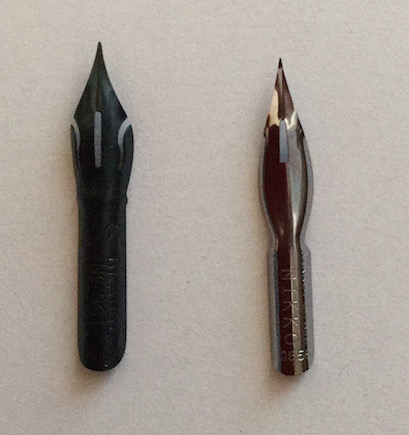
Below right is the Brause No. 361 Steno Pen and below left is the Nikko Nihon-Moji No. 555 pen.

IMG_0256

Both of these are current production pens and equally match the quality of vintage steel dip pens. Brause is German and Nikko is Japanese. They are excellent writing pens. The Brause is about a medium width and the Nikko is extra fine. You can find them at art supply stores in the calligraphy section. I also get them online from John Neal Bookseller.

Steel pens were first invented in 1803. Through technological refinement they became viable writing instruments in the 1830s and by the 1850s had replaced the quill pen as the writing instrument of choice. The steel pen remained in regular use well into the 1940s. I know folks who learned to write using steel pens, my father being one and a pen pal being another. They were using them in the 1940s.

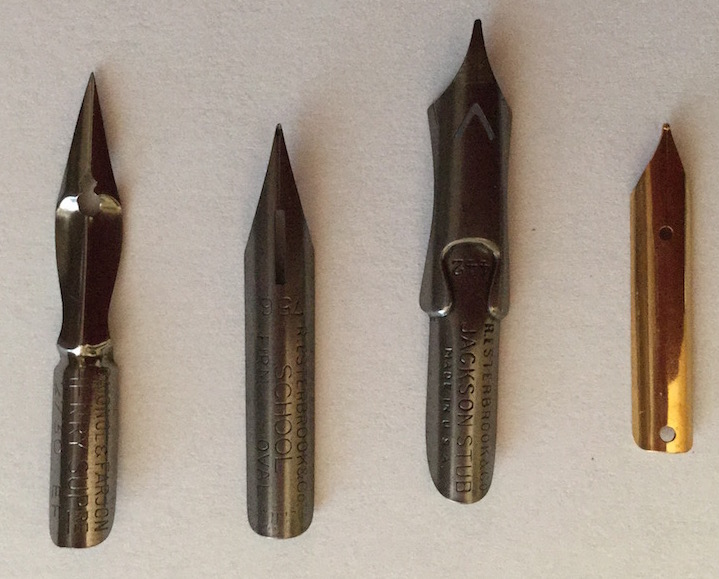
Vintage dip pens are available today. I get mine from eBay and my favorite place, Pendemonium. They are generally superior to any modern made dip pen. Below are 4 of my favorites.

IMG_0257

From left to right: Baignol & Farjon Henry Supérieure No. 2730EF; R. Esterbrook No. 756 School Fine Oval; R. Esterbrook No. 442 Jackson Stub; and the R.L. Arnold No. 736 Gold Plated, Iridium Tipped, Stainless Steel pen.

And yes, I regularly write with these pens. I find them easy on my tendonitis because they only need a light hand to produce a very readable line. In fact, I prefer them even to my beloved fountain pens because I can get by with even less pressure using a dip pen.

Give the steel dip pen a try! They are especially fun when you set out a bunch of your favorite colors of ink and have one pen for each color. Then have at it! Instant rainbow in more colors than gel pens can provide.

The retro-future is a great place to be!

Happy writing!

Sunday, June 21, 2015

8 Sentence Sunday On Dieselpunks #25

Rand Hart reads his mysterious note and sings opera! Here is today’s snippet:

The note inside, written in a large hand with a double-broad nib, read:

Dear Herr Hart,

Please do me the honor of meeting with me at your earliest convenience in the dining area promenade.

Respectfully yours,
von Osler

Hart tossed the note and envelope into the wastebasket. “Wonder what the hell he wants?” he said to the mirror and then took a look at the ring on his right hand.

With a perturbed look on his face, Hart gathered his clothes and shaving kit and went to the shower. A man was just coming out. Hart nodded his head in greeting and the man did likewise. When he left, Hart entered the shower and turned the water on. The temperature was good. The pressure, abysmal. He lathered up and rinsed off, singing “Amor ti vieta” from the opera Fedora by Giordano.

To be continued!

If you write or read Dieselpunk, join in the fun: 8 Sentence Sunday on Dieselpunks.

Tuesday, June 16, 2015

Exclusive—To Be Or Not To Be

We’re talking Amazon here and their KDP Select program. When an author enrolls digital books in KDP Select, they cannot be sold elsewhere. Period. The ebook is exclusive to Amazon. The benefit? The book can be borrowed by Prime and KDP Select customers and the author gets a royalty for the borrow — and the borrow counts as a sale. Amazon has just introduced a change to the program as to how money is paid out. Payout is now going to be based on pages read. Which may or may not be a good thing. 

I enrolled in KDP  Select on January first of this year and cancelled my participation as of the end of June. Why did I do so when 95% of authors re-enroll? Because I wasn’t seeing any significant benefit. Sure I got some borrows and got about half of the royalty I would have gotten had the book been purchased. Of course one can argue half a payment for a borrow is better than no payment at all and there is truth there.

From my experience, total borrows ended up less than total sales. My book was tied up with Amazon which meant I could not have my ebook for sale anywhere else. Not on Apple’s iBooks, not on Barnes and Noble, not on Kobo, not on Scribd, not anywhere. Granted indie authors have repeatedly reported the majority of their income comes from Amazon. Sometimes all other venues combined don’t even equal Amazon sales. Nevertheless, I couldn’t help but wonder if trying those other outlets wouldn’t be better than just limiting myself to Amazon. 

I don’t like monopolies and let’s face facts, in the book business Amazon is darn near a monopoly. Their sales clout was used to punish Hachette in their recent negotiations with Amazon when Hachette didn’t kowtow to Amazon’s wishes right away. What is to say that at some point, Amazon, in pursuit of the almighty dollar (which is why businesses are in business), won’t use that same clout to extract better deals from indie authors? That was Kobo President Michael Tamblyn’s point in his warning to Indie Authors.

I love Amazon because their site is easy to use and they offer just about everything. I hate Amazon because they are a monster. They are not unlike Walmart when the mega-box store chain moves into a small town and destroys the local businesses. (Which I witnessed first hand.) I don’t shop at Walmart. I’m coming to the point where I no longer want to buy from Amazon. Hence part of my reason to spread my digital books around.

The Kindle started the ebook revolution, so to speak. But I still get most of my books from the iTunes store. My iPad allows me the freedom to buy books from anywhere. I’m locked into no one purveyor. In October of last year, Apple announced over 225 million iPads have been sold. Compared to around 44 million Kindle devices through 2013. Clearly there are more iPads around than Kindles. And if readers who are also iPad users are like me, they will have Kindle and Nook apps on their iPads. So the question begs to be asked, why limit my books to Amazon when they have one-fifth the devices of Apple? And we haven’t even looked at Nook and Kobo yet.

That was dieselpunk author John Picha’s point. It makes sense one wants to be in the iBook store and elsewhere.

The other point that I found frustrating with Amazon’s KDP Select program was that I didn’t get any aid in marketing my books. Here I am exclusive with them and they do nothing to help promo my titles. Oh sure there is the give away or the Countdown special, but Select authors don’t get any special recognition. Our books aren’t put before the public eye. I still have to do all of my own advertising to get discovered. So again I ask, what’s the point? I basically get nothing being an exclusive author. A couple piddly tools to give away my book or sell it for less. I don’t need to be exclusive to Amazon to do that.

It seems to me, if Amazon really wants to make exclusivity attractive they need to sweeten the pot. Give exclusive authors more visibility so they can get discovered and sell lots of books. Benefits the author and benefits Amazon. Instead Amazon is simply trying to corral all the indie authors with smoke and mirrors.

This is my experience. Other authors have benefited from the program. I haven’t to any significant degree. Therefore, I’m pulling out and seeing what happens. I may go back to being exclusive. Then again I may prefer my eggs being in more than one basket.


Sunday, June 14, 2015

8 Sentence Sunday On Dieselpunks #24

In today’s snippet, Rand Hart gets a mysterious envelope:

Hart was roused from sleep by someone knocking on his cabin door. He got out of bed, went to the door, and called out, “Yes? What is it?”

“A message for you, sir.”

Hart slipped on his robe over the pajamas and opened the door. The steward handed him an envelope.

“Just a minute.” Hart rummaged through a drawer and gave the man a dollar.

“Thank you, sir.”

“You’re welcome.” Hart closed the door, sat on his bed, and opened the envelope.

To be continued!

If you write or read Dieselpunk, join in the fun: 8 Sentence Sunday on Dieselpunks.

Tuesday, June 9, 2015

Interview with Justinia Wright, PI

Today it is my privilege to interview the famous Minneapolis private investigator, Justinia Wright. I’m sitting in the equally famous oxblood oversize wingback in her office, where many have sat before me in much less happy circumstances.

cwh: Miss Wright, thank you for agreeing to this interview.

JW: You are very welcome.

cwh: To begin, how long have you been a private investigator?

JW: Eight years.

cwh: And before that you worked for the CIA, is that correct?

JW: Yes. I worked seven years for The Company.

cwh: What made you leave and decide to become a PI?

JW: I can’t give you specifics. Let’s just say I didn't see eye to eye with my boss and what he was asking me to do. As for becoming a PI, I didn’t do that right away. I opened an art gallery and sold art with a partner for two years.

cwh: Where was that?

JW: In San Francisco. When that didn’t work out, I moved to Minneapolis and got my private investigator’s license.

cwh: Why Minneapolis?

JW: The Twin Cities aren't an overly large metro area, yet are large enough. There is a wonderful mix of cultures and the area offers many opportunities for musical and artistic expression.

cwh: So why become a PI?

JW: From my time in the CIA, I knew how to get information and perform surveillance. In a sense, it was going back to what I knew without all the bureaucracy.

cwh: How is being a spy similar to being a private investigator?

JW: As I mentioned, gathering intelligence and conducting surveillance. Where it differs, is that I have to do my own analysis.

cwh: To date, what has been your most difficult case?

JW: [She rests her chin on steepled fingers for a few moments before answering.] I’d be inclined to say the case Harry has called Festival of Death.

cwh: Harry’s your brother and assistant, right?

JW: Yes, that is correct. He and Bea, his wife, keep the office and household running efficiently. [She pauses.] Although the case he is currently writing up, about the poor murdered minister, was quite puzzling. So either of those.

cwh: Do you investigate yourself or do you have a support team?

JW: A team. The best team. I don’t know where I’d be without David Nagasawa, Gwen Poisson, and Ed Hafner. Or Harry. I do a little field work. Mostly, though, I work as a handler, so to speak, and analyze the information I receive.

cwh: Do you find being a woman to help or hinder you?

JW: I don’t find being a woman to help or hinder. There are many more women in the business now than ever before. What matters is if you get results. And I get results.

cwh: Do you work often with law enforcement?

JW: Yes, I do.

cwh: How would you describe your experience?

JW: Overall, I’d say positive. I’m frequently called in to assist on difficult homicide cases, something I like very much. They especially like getting results and I, of course, get results.

cwh: Do you have a liaison?

JW: Yes, Lieutenant Cal Swenson of Homicide.

cwh: Now, Harry has given us a certain picture of your relationship with Cal. Is that picture accurate?

JW: Cal and I are friends and I think I’ll leave it at that.

cwh: What motivates you as an investigator?

JW: My sense of justice and fairness.

cwh: I understand you can be difficult to work with sometimes. Do you care to comment on that?

JW: [A big smile appears on her face.] Depends on how you define “difficult”. Do I expect competency? Yes. If that is being difficult… [She shrugs.]

cwh: Competency, yes. But what about your interactions with your clients and Lieutenant Swenson? As your brother portrays those interactions, well, it just seems—

JW: That I’m difficult? Well, that’s Harry. He does tend to get a bit melodramatic in my opinion. Sometimes, clients don’t know what they know or what they think they know can impede an investigation. My job is to cut through the crap, so to speak, so I can help them.

cwh: And Cal?

JW: The police are a bureaucracy. Sometimes Cal is a bureaucrat against my better judgement. All in all, I don’t think I’m any more difficult to work with than anyone else.

cwh: You’re an amateur painter and pianist. Any thoughts about going professional?

JW: No. Not really. But I do like painting and performing, so who knows?

cwh: I see our time is up. Thank you very much, Miss Wright for giving us this opportunity to give your fans a bit more information about you.

JW: My pleasure.

You can see Justinia Wright in action in Festival of Death and Trio in Death-Sharp Minor, available on Amazon and soon in other fine online retail establishments.

Tuesday, June 2, 2015

Review: Apocalyptic Pub Lunches by Erik Ga Bean

Erik Ga Bean is a most interesting author. I ran across him and his novel A Trifle Airship on Twitter. I purchased the book, thoroughly enjoyed it, went on to purchase Mrs Fatterbottom’s Burden, and now have completed Apocalyptic Pub Lunches.

Apocalyptic Pub Lunches may be purchased from Smashwords. And for a mere 99¢.


I thoroughly enjoyed Apocalyptic Pub Lunches. The storyline is simple and basically character driven. A format I like very much. The author provides us with people who are less than ordinary in mostly ordinary situations, which provides a light and subtle humor. We are also given a wry commentary on our daily lives. Interesting people who are often in exceedingly boring jobs and yet somehow survive.

The writing style is laid-back, like a Sunday afternoon stroll in the park. We are not hurried through this tale. There is no frenetic pacing. There is action and there is adventure, but it takes place at a leisurely pace. 

The story is divided into 6 vignettes. Each one is from one of the principal character’s point of view. The ending of the tale is, like much of the story, indirect. Something I rather like.

The only sour note comes is in textual integrity. Erik Ga Bean tells a good story. He knows how to write. However, proofreading was insufficient and I felt the final section could have had another read through by the author or an editor as it didn’t flow as well as the other sections.

Erik Ga Bean is a delightful author. A hidden treasure. I look forward to reading the rest of his oeuvre. He is quite good and very much recommended!